
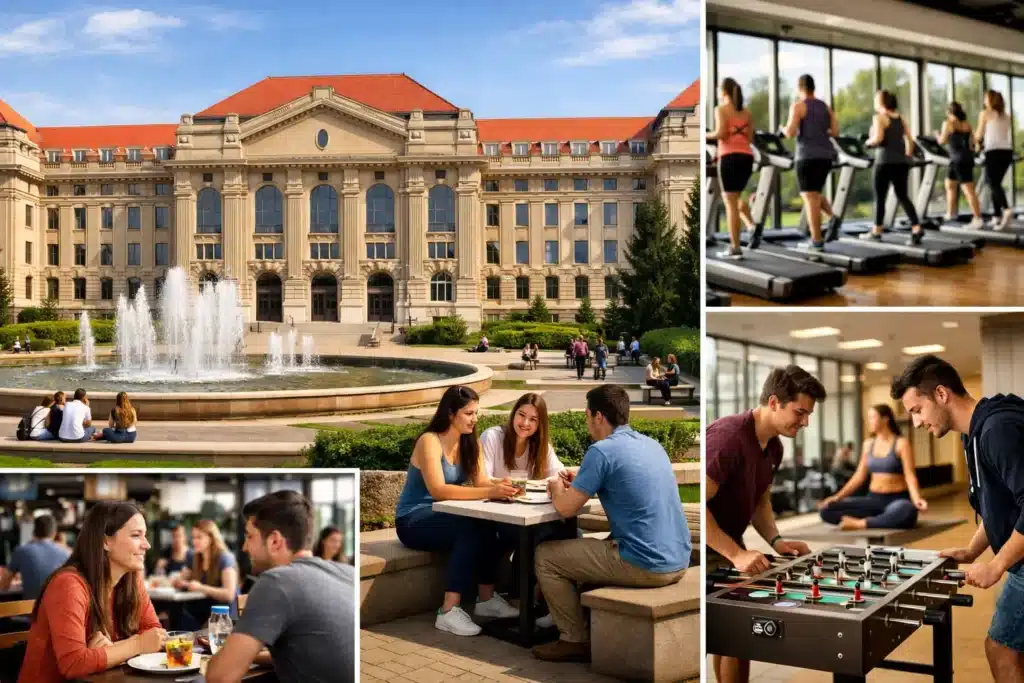
For students considering a degree abroad, the University of Debrecen facilities matter far beyond the prospectus. A medicine student needs realistic clinical learning environments; an engineering student needs access to specialist equipment; and every international student needs a place where studying, meeting people and settling into a new country feel manageable from day one.
Debrecen offers a large, established university setting with facilities spread across its academic campuses. The experience is not identical for every course – a medical student, for example, will spend more time around clinical and science buildings than a business student – but the university is designed around the practical needs of a broad international student community.
A campus environment built for serious study
The University of Debrecen is one of Hungary’s major higher education institutions, and its facilities reflect the scale of its academic portfolio. Students on English-taught programmes learn in purpose-built lecture theatres, seminar rooms and teaching spaces alongside students from many countries. This creates a more international atmosphere than many applicants expect before arriving.
The main university areas around Nagyerdei, or the Great Forest, combine academic buildings with green space, cafés, student services and nearby city amenities. It is a setting that can feel less overwhelming than a huge capital-city campus while still offering the infrastructure expected from a long-established university.
For students coming from the UK, Ireland or France, the practical advantage is proximity. Much of daily student life can be organised within a relatively accessible area, rather than requiring a long commute between lectures, accommodation and essential services. Your timetable and faculty location will determine the details, so it is sensible to check where your particular programme is taught before choosing accommodation.
Libraries and individual study space
A good library becomes particularly valuable during exam periods, when shared accommodation is not always the quietest place to revise. The university’s library provision gives students access to study areas, printed academic materials and digital learning resources needed for coursework and independent reading.
Different faculties may also have their own subject-focused collections or study spaces. This matters for students on intensive courses such as medicine, dentistry, pharmacy, public health, engineering and IT, where reading does not end when the lecture does. Library access supports the independent study habits expected in university-level education, while quieter spaces offer a useful alternative to studying in a room or busy café.
Laboratories, clinics and practical learning
Facilities are especially significant when your degree leads towards a regulated or hands-on profession. The University of Debrecen’s science, health and technical programmes are not based only on classroom teaching. They are supported by laboratories, practical teaching rooms and discipline-specific learning environments.
Medical, dentistry and pharmacy applicants should expect a demanding curriculum that develops scientific knowledge alongside practical competence. Teaching may involve anatomy, laboratory-based subjects, simulation and clinical elements as students progress through their course. The precise access, placement arrangements and clinical exposure depend on the year of study and faculty requirements, but the benefit of studying within a university with a major clinical presence is clear: professional learning is connected to real healthcare education and practice.
Students in engineering, computer science, agriculture and natural sciences likewise benefit from practical teaching. Specialist laboratories and technical spaces help turn theoretical modules into work that involves testing, analysis, design and problem-solving. For a student choosing between a course that sounds good on paper and one that prepares them for professional work, this is an important distinction.
Training for career-led degrees
The university’s range of facilities also supports programmes with very different professional outcomes. A pharmacy student may focus on pharmaceutical sciences and laboratory work, while a professional pilot student follows a training route with aviation-specific requirements. Business students may spend more time in lecture, seminar and collaborative project settings. There is no single “best” facility across the university – the right question is whether the learning environment fits the course and career you are pursuing.
Before applying, ask about the facilities most relevant to your programme rather than relying on general campus descriptions. It is worth clarifying where teaching takes place, what practical components are included and whether you will need to travel between sites. Clear answers early on make planning your move much easier.
Student accommodation and everyday comfort
On-campus accommodation is often one of the first concerns for international students and their families. University accommodation can offer a more structured start to life in Debrecen, particularly for first-year students arriving without an existing local network. It puts students close to campus and makes it easier to meet classmates from the first weeks.
Accommodation options can vary by residence, room type and availability. Applying early is important, especially if on-campus living is a priority. Students should also consider what matters most to them: being as close as possible to their faculty, having a more social residence experience, or choosing greater independence in private accommodation.
The wider city supports day-to-day student living with supermarkets, pharmacies, cafés, public transport and places to eat. Debrecen is a significant Hungarian city, but it remains more compact and easier to get around than many major European capitals. That can be reassuring for students who are living abroad for the first time and for parents who want a practical, organised environment rather than a difficult daily commute.
Sport, wellbeing and life beyond lectures
University life should not become a cycle of lectures, revision and sleep. The University of Debrecen has sports facilities and opportunities that allow students to stay active, join activities and build a routine outside their course. Whether you are already committed to fitness or simply want an accessible way to manage the pressure of a demanding degree, sport can make a genuine difference to your experience.
The Great Forest area also gives the campus a distinct character. Green surroundings, walking routes and nearby recreational spaces offer a break from study without needing to leave the city. For students used to busy urban environments, that balance between a professional university setting and open space is a real advantage.
Wellbeing is also shaped by the everyday basics: knowing where to go for support, having classmates nearby and being able to settle into a routine. International students often find that the first month is the biggest adjustment. Campus-based services and student communities can make that transition feel far less isolating.
Getting the most from University of Debrecen facilities
The facilities available to you are only useful if you plan around them. Once you receive an offer, look at your faculty location, accommodation options, likely timetable and how you will travel around the city. If you are taking a laboratory-heavy or clinical course, allow for a schedule that may be more structured than a typical lecture-based degree.
It is also wise to arrive with realistic expectations. A university with multiple faculties and campuses will not feel the same every day, and some services will be busier at peak times. Yet this scale brings an advantage: students have access to academic, practical and social resources that support a full university experience rather than a course in isolation.
For applicants who want guidance before making a decision, Study Abroad Hungary can explain the practical side of the University of Debrecen experience, from programme locations to admissions preparation and pre-enrolment planning. Choosing where to study is not only about the degree title. It is about whether you can picture yourself learning, living and progressing there with confidence.