
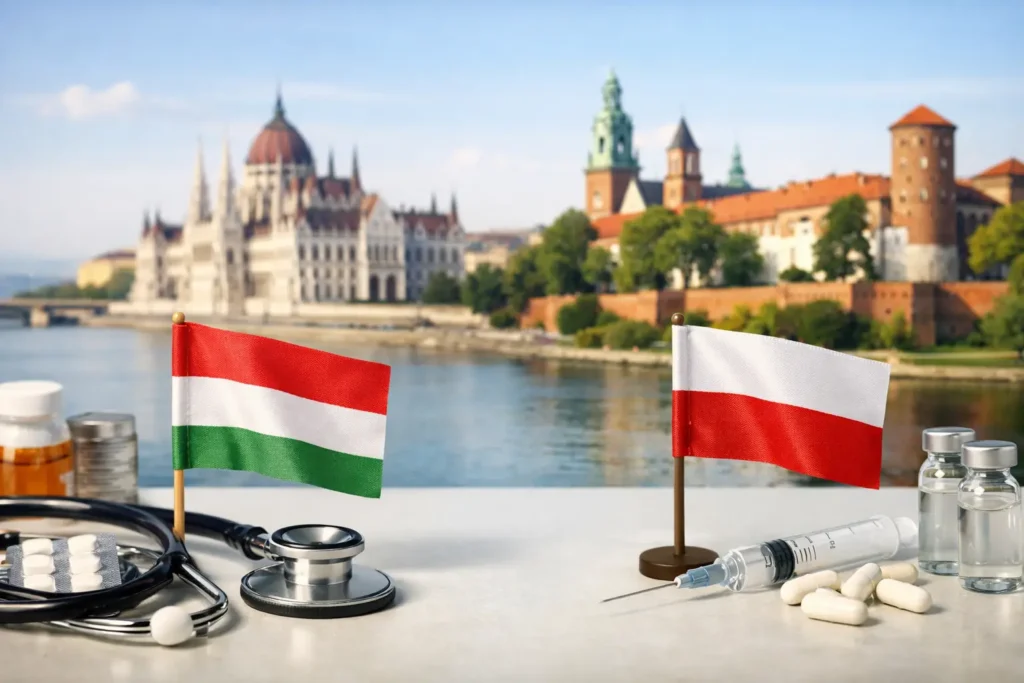
If you are weighing up Hungary or Poland medicine, you are probably not choosing between two random destinations. You are choosing between two serious European routes into an English-taught medical degree when home options feel too narrow, too competitive or simply too uncertain. That makes the decision less about country labels and more about where you are most likely to thrive, progress and graduate with confidence.
For many students and parents, the real question is not which country sounds more familiar. It is which system offers the clearer admissions route, the stronger day-to-day support and the better fit for a demanding course like medicine. Both Hungary and Poland attract international applicants, but the student experience can differ in ways that matter once lectures begin and the novelty wears off.
Hungary or Poland medicine: what actually matters?
Medicine is not a course where you can afford to choose on instinct alone. The better comparison looks at admissions, academic structure, clinical exposure, living environment and how supported you are before and after arrival.
A common mistake is to focus only on the idea of studying in Europe in English. That is a good starting point, but it is not enough. You need to know how selective the process is, whether entrance preparation is manageable, how established the English-language pathway is and whether the university is set up to support international students properly.
Hungary has a long-established reputation in English-taught medical education, and that matters. At the University of Debrecen, medicine has been delivered to international students in English for decades, which means the systems around teaching, assessment and student support are mature rather than improvised. That kind of stability can make a real difference when you are adapting to a new country and one of the most demanding degrees available.
Admissions and entry expectations
One of the biggest decision points in Hungary or Poland medicine is how the admissions process works in practice. Many applicants from the UK, Ireland and France are not just looking for a place. They are looking for a route that is clear, fair and realistic.
In Hungary, entry to medicine typically involves meeting academic requirements and passing an entrance examination or interview process, depending on the university’s procedures. For students who are strong in biology and chemistry but may have missed out on a domestic offer, this can feel more transparent than waiting on highly compressed home admissions cycles. It rewards subject readiness and preparation rather than relying on one narrow route.
Poland also offers English-taught medicine with competitive admissions at several institutions. The exact process varies more noticeably by university, and applicants often need to spend time comparing different models, requirements and testing formats. That does not make Poland a poor option, but it can make the process feel less straightforward if you do not already know the landscape.
For students who want a more guided path, having direct help with documents, timelines and entrance preparation can remove a lot of uncertainty. That is often where the difference lies – not in whether a place exists, but in how manageable it feels to get there.
Teaching quality and English-taught delivery
When families compare Hungary or Poland medicine, they often ask whether the English-language programme is fully integrated or simply adapted for overseas recruitment. It is a sensible question.
In Hungary, well-established universities such as the University of Debrecen have built extensive English-taught medical pathways with international cohorts, experienced faculty and a structure designed around students arriving from different education systems. That tends to create a more consistent experience from first year onwards. You are not entering a side programme. You are entering a recognised international track within a major university.
Poland also has respected medical universities and English-taught courses, but consistency can vary by institution. Some are highly experienced with international delivery, while others may feel less internationally embedded in the day-to-day student experience. This is why comparing country against country only gets you so far. The university itself matters at least as much as the destination.
Clinical training and long-term confidence
Medicine becomes more real once you move beyond pre-clinical teaching. Students need to think about hospital exposure, clinical organisation and how well the programme prepares them for the next stage of training.
Hungary’s stronger medical universities have a well-developed structure for moving students from foundational science into clinical learning. In Debrecen, for example, the wider university and teaching environment are closely connected, which can help make the transition into practical medicine feel more coherent. That matters for confidence as much as competence.
Poland can also provide solid clinical training, but again the experience depends heavily on the institution and the hospital network attached to it. A broad country comparison does not capture those differences. If you are serious about medicine, you should look beyond the brochure language and ask how clinical years are organised, how international students are supported and how the programme prepares you for licensing or next-step applications after graduation.
Student life, safety and day-to-day adjustment
This part is often underestimated. Students do not just need a medical school. They need a place where they can settle, study and function well under pressure.
Hungary is often appealing because cities such as Debrecen offer a more student-focused environment with a strong university identity. For many first-time international students, that can feel less overwhelming than a larger, more fragmented city experience. Daily life tends to be easier to get your head around when the university plays a central role in the city and international students are a familiar part of the local picture.
Poland offers a wider range of city experiences, from large urban centres to more regional settings. That can be a positive if you want more choice, but it also means more variation in atmosphere, accommodation patterns and how internationally oriented the local environment feels.
Parents often care as much about this section as students do. Safety, accommodation, transport and practical support all shape whether a student settles quickly or struggles for the first term. A medically rigorous programme is only an advantage if the student can actually adapt to life around it.
Recognition, mobility and future planning
Students choosing Hungary or Poland medicine usually have one eye on the future from day one. They want a degree that is internationally recognised and gives them options later, whether that means returning home, moving within Europe or pursuing further training elsewhere.
Both countries are established within European higher education and both can offer recognised medical degrees through the right universities. But recognition is never something to treat casually. Students should always consider the standing of the specific university, the structure of the programme and the requirements of the country where they may wish to train or practise later.
This is where clarity matters more than marketing. A well-known university with an established international medicine programme can give families more reassurance than a newer or less proven option, even if both sit within the same country.
Why many students lean towards Hungary
For students looking for a dependable, English-taught route into medicine, Hungary often stands out because it combines academic tradition with a relatively clear international admissions pathway. That does not mean it is right for everyone, but it does mean the route can feel more structured.
The University of Debrecen is a strong example of why. It is internationally recognised, experienced in teaching medical students in English and supported by systems that are familiar with international applicants from start to finish. For students who want medicine without unnecessary friction, that practical side matters.
There is also reassurance in studying at a university where international students are not treated as an afterthought. From admissions guidance to pre-arrival questions, a smoother process can reduce stress before the course even begins. For applicants coming from the UK especially, where medicine entry can feel brutally narrow, that difference is significant.
So, Hungary or Poland for medicine?
If you are comparing Hungary or Poland for medicine, the honest answer is that both can work – but not for the same student in the same way. Poland may suit applicants who want a broader range of city and university options and are comfortable doing more independent comparison work. Hungary may suit students who want a more established English-taught route, a highly international study environment and a clearer sense of academic and practical support.
If your priority is a university with long experience in international medical education, a structured admissions process and a student-friendly environment, Hungary deserves very serious attention. And if you want the decision to feel less like a gamble and more like a planned next step, that is often where Hungary has the edge.
The best choice is the one that gives you the strongest chance not just to start medicine, but to stay on course and succeed once you are there.